Why review had to change
Across Anthropic's monorepo, changes landing per day went from about 2,500 in May to more than 30,000 in September. Claude Code lives in its own repo but feels a lot of that pressure too, and line-by-line human review at that pace is close to impossible. So they named the scarce resource: human time and attention. They track human approvals per PR, human comments and how long a PR waits on a person, with revert and incident rates as the guardrail.
Review now runs continuously, "more like spellcheck while you write," across seven layers:
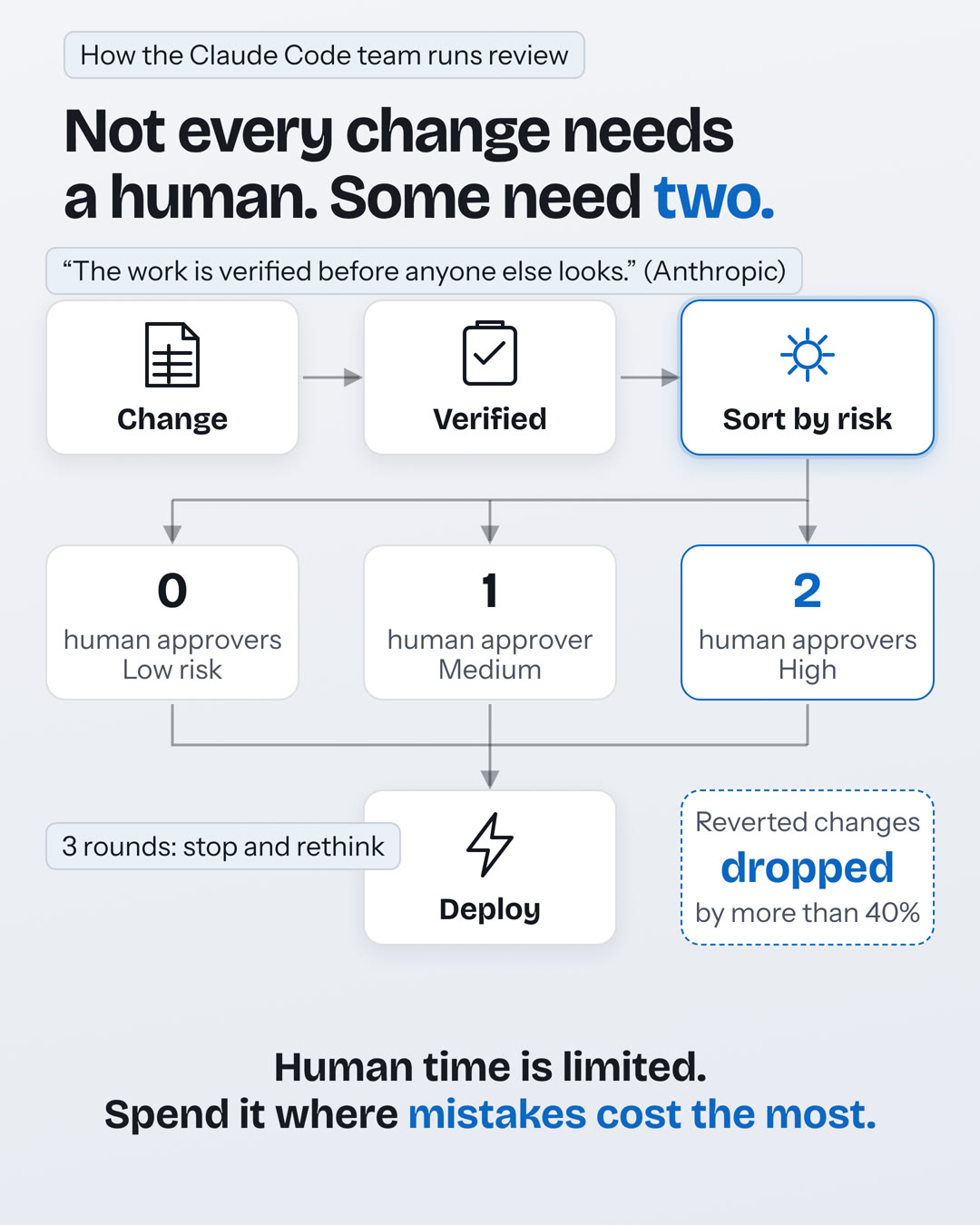
- The work is verified before anyone else looks
- AI review on every pull request
- Security review that can block
- Automated checks that block
- Human approval, scaled by risk
- Merge queue, flags and a gradual release
- Fast detection, fast rollback
The tiers
| Risk | Examples | Human approvals |
|---|---|---|
| Low | Docs, copy, internal-only features, additive changes behind a flag | None, once automated review and security checks are green |
| Medium | Ordinary product changes, and sensitive areas like caching, the auto-updater or system prompts | One person |
| High | The highest-risk code, plus a small set of paths that always need two people | Two people |
"The change sets the tier, not the author."How the Claude Code team does code review, Oct 15, 2026
A classifier reads the change and picks its risk tier, so nobody gets to talk their own change down to "low." Two more rules keep the light paths honest: only authors on the repo's trusted list (mostly the team that owns it) get them, and an agent's approval never counts as a person's.
Verified before anyone looks
Their first layer is the one to copy. Give the agent something it can run (tests, a build, a screenshot to compare against the design) and ask it to show the output instead of saying it's done. Then a subagent reviews the diff with fresh context.
Per the post, Boris Cherny estimates that giving Claude a way to verify its work makes the final result two to three times better. Claude Code's best-practices guide says it directly: without a check it can run, "looks done" is the only signal available, and you become the verification loop.
When review won't settle
After three rounds, the reviewer asks the author to step back and reconsider the approach. With that cap and a few related rules, internal PRs settled in fewer rounds:
The headline result: from June to September, merged pull requests more than doubled while the share that had to be reverted fell by more than 40%.
Block does it at migration scale
Block shared a similar setup on Oct 8. In any given migration they might merge about a thousand pull requests orchestrated by Claude Fable, which directs up to dozens of smaller models like Opus or Sonnet for the individual tasks. Agent changes have to pass security checks, then two humans approve the deploy: a dual-approval layer, so no model pushes those changes alone.
Why tiers work
Approve everything and the clicks stop meaning much. Claude Code's own guide says it about permission prompts: "After the tenth approval you're clicking through rather than reviewing." Tiers save human attention for the changes where it counts.
The same idea, scaled down
My personal AI setup runs three tiers:
| Action | What happens | Who approves |
|---|---|---|
| Edits to my own files | Just run | Nobody |
| Drafts, like emails | Get written, then wait | Me, before anything goes out |
| Sends to anyone but me | Need my yes; in the most hands-off mode a hook blocks them outright | Me, every time |
Human time is limited. Spend it where mistakes cost the most. Where do you draw the line between "just do it" and "wait for me"? Tell me on LinkedIn.
Sources and further reading
Every number on this page comes from these. The three-tier setup is my own.